
If posting more was the answer, every small business would be smashing it on social media by now.
But that’s not what I see.
I see business owners showing up consistently, doing “all the right things”, and still wondering why the enquiries haven’t changed. More posts. More platforms. More effort. Same results.
The problem isn’t effort.
It’s strategy.
In the past, simply being active could get attention. Today, algorithms are far more sophisticated. They’re not just counting likes or comments – they’re trying to understand what you’re actually saying, who it’s relevant to, and whether it adds anything meaningful.
In simple terms: noise gets filtered out faster. Useful content gets rewarded.
2026 isn’t the year to post more and hope for the best. It’s the year to get clearer, more intentional, and far more selective about what you are saying and where you spend your time.
Here’s what actually works – and why.
Why posting more stopped working
Social media isn’t optional anymore. For most UK businesses, it’s where customers discover you, decide whether they trust you, and often make their buying decisions.
The scale alone makes that clear:
- Around 55.5 million people in the UK use social media – roughly 79% of the population
- Nearly half of UK adult internet users use social media to research brands and products
- People juggle an average of SIX platforms a month
- Almost 97% of UK SMEs now use social media to grow their business
Your audience is there.
So are your competitors.
That’s exactly why volume has lost its edge. When everyone is posting, more content doesn’t make you stand out – clearer content does.
If you don’t define success, nothing will feel like it’s working
This is where some businesses trip themselves up.
Before you post anything, ask yourself one simple question:
What is this post meant to achieve?
Not “be visible”. One clear outcome.
Is it meant to:
-
Drive clicks to your website?
-
Generate enquiries or bookings?
-
Build trust so people think of you first?
-
Grow your email list?
Pick one.
Once you choose a primary goal, everything becomes easier – the content you create, the call to action you use, and what you measure afterwards.
Posting without that clarity leads to chasing likes, views and reach that don’t translate into real business results.
Once you have a clear goal, the next step is choosing platforms that actually support that goal – not just where posting feels easy.
Being everywhere is the fastest route to burn out
One of the most common questions I hear is:
“Should I be on every platform?”
Short answer: no.
Most UK business owners are time-poor. Trying to show up everywhere usually means spreading your energy too thin. A more effective approach is to choose platforms based on what you want to achieve.
Here’s how to think about it:
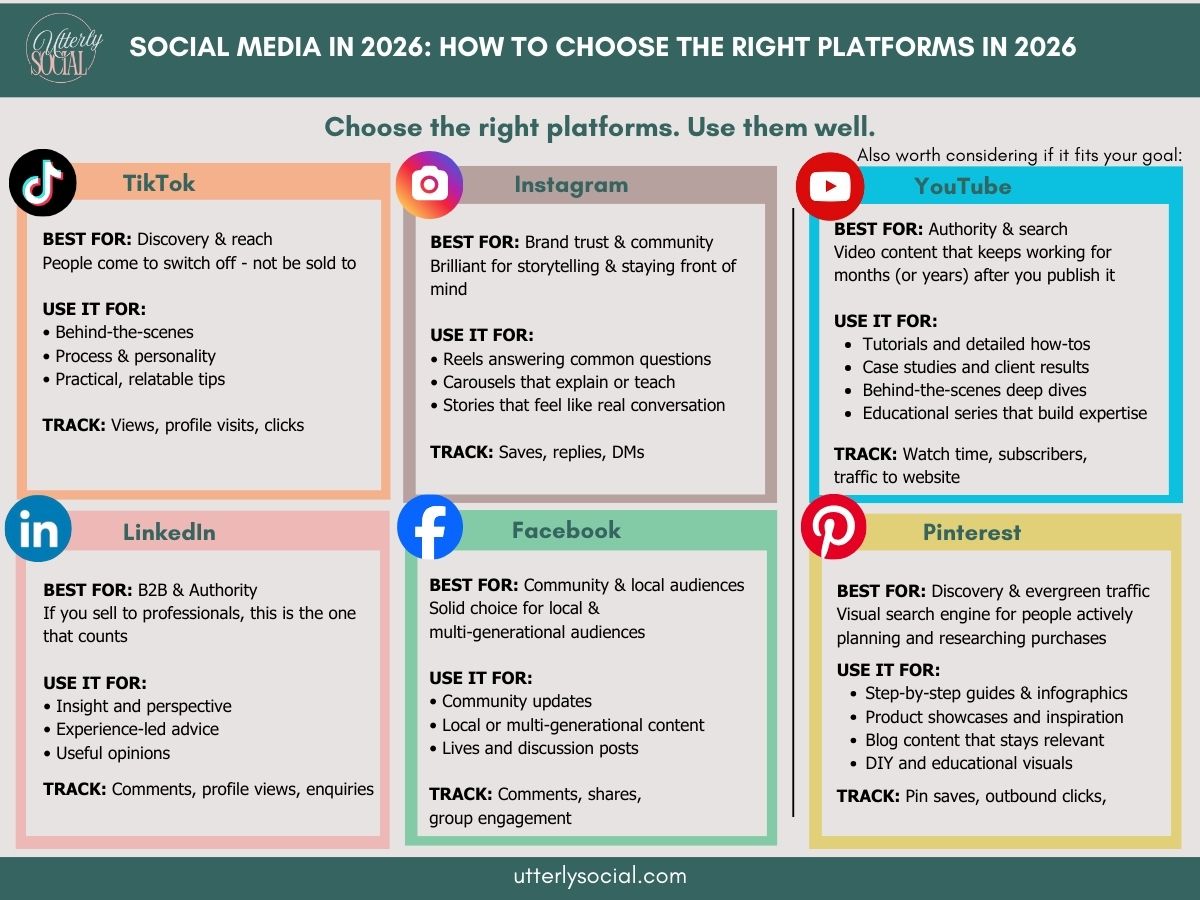
TikTok = awareness and reach
With 23-25 million UK users (38% of adults), TikTok is built for discovery. People come here to be entertained and switch off, not to be sold to. That’s exactly why it works for awareness. Human, useful, behind-the-scenes content travels far – polished sales content doesn’t. Use it to show process, personality and practical value – just be clear it’s not designed for quick conversions.
Instagram = brand trust and community
Instagram reaches 34-35 million UK users and remains strong for storytelling and staying front of mind. Reels that answer common questions, carousels that explain things clearly, and Stories that feel conversational all help build trust over time.
LinkedIn = B2B and credibility
With 42-44 million UK users, LinkedIn matters if your audience is professional. People expect insight and perspective here, not adverts. Experience-led advice, opinions and useful commentary tend to outperform anything overly polished.
Facebook = community and local audiences
Facebook reaches 42-51 million UK users. Not fashionable but still effective for the right businesses. Facebook remains powerful for groups, events and local or multi-generational audiences. It works best where conversation and community matter.
YouTube = authority and long-term value
YouTube isn’t about quick wins – it’s about building authority that compounds over time. Video content you publish today can still be driving traffic and enquiries months or even years later. If you’re willing to invest the time upfront, tutorials, case studies, and educational series position you as the expert in your field. Just know it requires more effort than other platforms – both in production and consistency.
Pinterest = discovery and evergreen traffic
Pinterest works differently to other platforms – it’s a visual search engine, not a social network. People use it to plan, research and save ideas for later. If your business suits visual content (products, guides, infographics, how-tos), Pinterest can drive steady traffic long after you’ve posted. It’s particularly strong for e-commerce, lifestyle, DIY and educational content that stays relevant over time.
You don’t need every platform. You need the right ones.
Content without purpose is just busy work
Posting for the sake of it is one of the biggest drains on time and energy.
Instead of asking “What should I post today?”, start with “What would actually help my audience right now?”
Simple, effective content ideas include:
-
Practical how-tos
-
FAQs you answer all the time
-
Customer stories or testimonials
-
Behind-the-scenes insights
-
Seasonal or timely hooks
Content that helps first, sells second, and gives people a reason to stick around. And here’s what works everywhere: real beats polished. Authenticity matters more than production value on every single platform.
Consistency beats frequency – every. single. time.
Posting every day isn’t necessary – or even helpful – for most businesses.
Consistency matters not because you’re posting often, but because platforms are looking for patterns over time. They want to see relevance, not bursts of activity.
Two thoughtful, well-planned posts a week will usually outperform seven rushed ones that disappear without impact.
If you’re short on time (and who isn’t), batching helps:
-
Plan your posts in one go
-
Write captions in one sitting
-
Schedule ahead
Save your best energy for thinking and engaging – not scrambling to post for the sake of it.
Engagement comes from content people actually care about.
That’s why purpose matters: if your content doesn’t have a job, measurement is meaningless – and measurement is the only way to know what’s actually working.
Measure what leads somewhere
It’s easy to focus on likes and follower numbers because they’re visible. But they rarely tell the full story.
What matters more in 2026:
-
Clicks and link interactions
-
Comments and saved posts
-
Enquiries, messages and bookings
-
Reach that leads to meaningful engagement
When something performs well, ask why. Then double down on what’s actually working.
You don’t need a big budget – you need a clear plan
It’s easy to assume social media success requires a huge team or expensive content production. It doesn’t.
Some of the most effective social strategies come from small UK businesses being clear, consistent and genuinely useful.
Take the Mysterious Bookcase in Bournemouth. They used TikTok to run a simple “Blind Date with a Book” campaign – quirky, authentic content that resonated. It drove enough interest to open a physical shop.
Over 1.5 million UK companies are now using TikTok. Not all of them are winning – but the ones who are have something in common: they know what they’re trying to achieve, and they’re consistent about showing up.
You don’t need to go viral. You just need to be intentional about who you’re talking to and what you want them to do next.
The businesses winning aren’t necessarily spending more – they’re thinking more clearly.
So what do you actually do?
If you’re ready to stop posting more and start posting better, here’s where to begin:
1. Get clear on your goal What does success actually look like? Website traffic? Enquiries? Building trust? Pick one primary objective and build everything around it.
2. Choose your platform strategically Don’t try to be everywhere. Pick 1–2 platforms where your audience actually is, and focus your energy there.
3. Create content with a purpose Every post should have a job. Educational, proof, personality or conversion – know what you’re trying to achieve before you hit publish.
4. Prioritise quality and consistency Two great posts a week will always beat seven mediocre ones. Batch your content, repurpose what works, and save your energy for strategy.
5. Measure what matters Track clicks, engagement and conversions — not just likes. When something works, ask why. Then do more of it.
Social media doesn’t have to be overwhelming. But it does need to be intentional.
Be strategic. Be consistent. Be human.
Do that, and 2026 will be the year it actually works.