
Nobody wants to see your products
Except plenty of people do. One Insta post sent me down a research rabbit hole about products, personality and what actually earns attention on Instagram.
On Sunday morning Jo, who runs the gorgeous homeware brand @sosouk, posted a ten-slide carousel that managed to press almost every small-business Instagram bruise at once.
Do followers want the products or the person behind them? Do behind-the-scenes posts and talking-to-camera videos build a connection, or make people scroll past at speed? Are trends still useful?
And when, exactly, did selling lovely things also mean taking on a second job as a content creator?
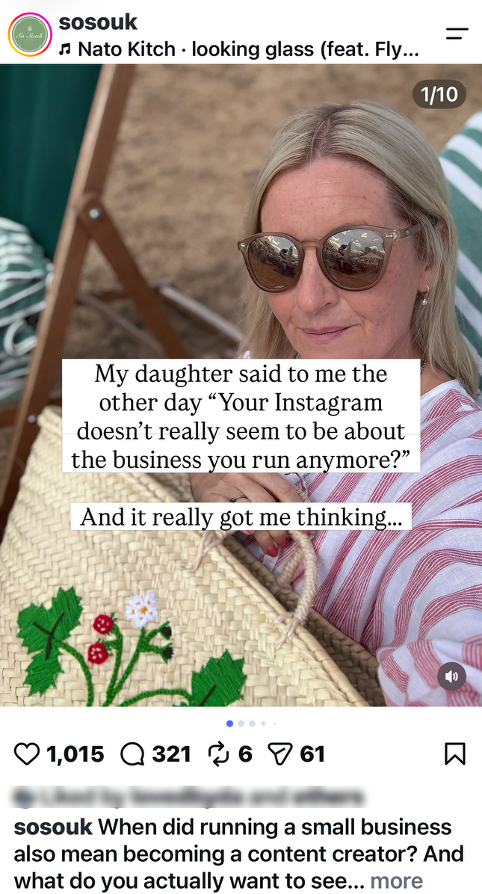
The post that started the conversation: @sosouk, 23 August 2026.
It was the interesting bit for me, because the questions were bigger than one account. So I read every comment, grouped the responses and checked them against the wider research to see what small businesses can actually use – and what they can stop tying themselves in knots over.
What happened in Jo’s comments
By 10.22am on Monday, the post had more than 1,000 likes and 322 comments. Remove Jo’s 85 replies and that leaves 237 comments from 209 people. I counted each person once, based on everything they wrote.
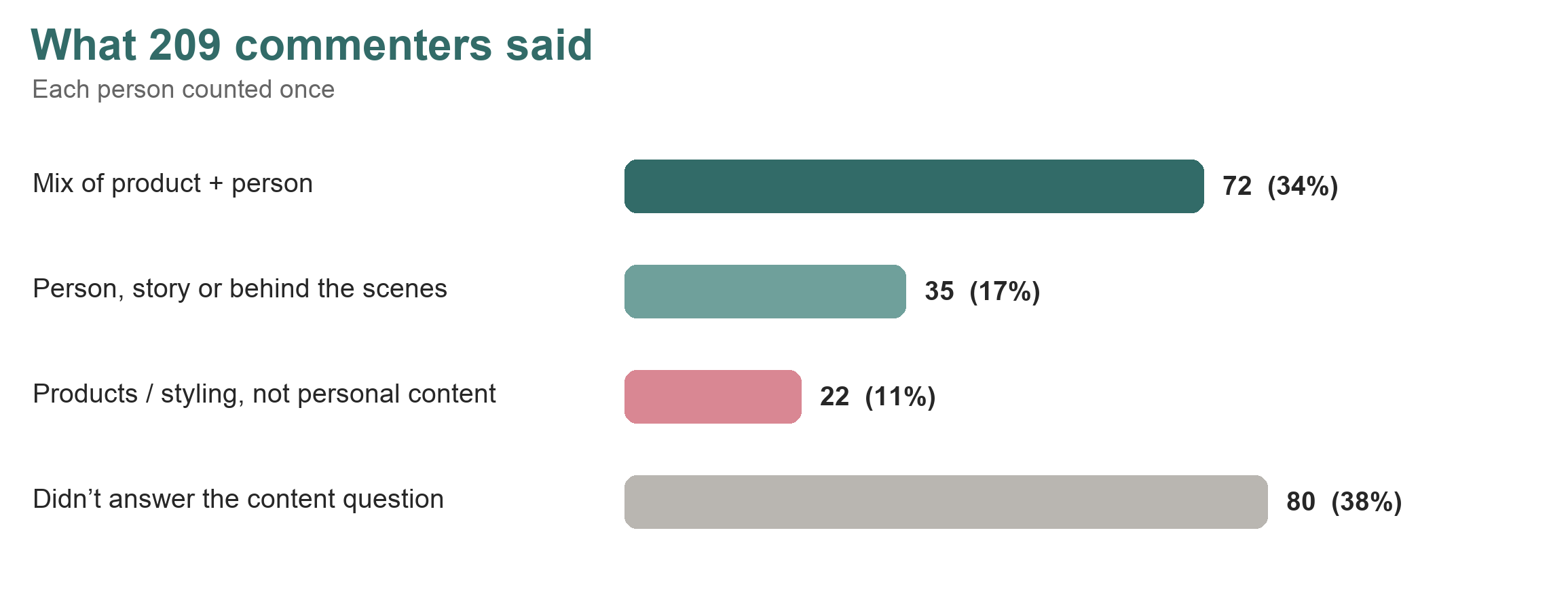
A self-selecting comment section on one post – not the ONS with prettier cushions.
Of the 129 people who answered the content question, most wanted a mix of product and person. But the disagreement matters. Some wanted more of the founder; some switched off the moment anyone spoke to camera; others followed a business precisely because they liked the calm, beautiful product imagery. There is no single content rule that will make all three groups happy. Frankly, I’m not that surprised.
The clearest reaction was to trends: 33 people said something negative and five said something positive. That is not a vote to ban every trending dance from the internet. It is a reminder to use a trend only when it fits the business and you have something of your own to add. Lip-syncing beside a stack of invoices is not a strategy.
The bit I found most revealing was the 80 people who did not answer Jo’s questions at all. They talked about their own falling reach, algorithm confusion and exhaustion instead.
And Jo’s commenters aren’t the only ones feeling like this. Censuswide’s July 2026 survey of 501 UK small-business owners found 76% feel pressure to be on social media, 55% create content simply to stay visible and 60% would rather be getting on with their actual work. Quite right too. Presumably that work was not ‘feed the content machine from morning to night’.
So, what content actually works?
There isn’t a useful answer as simple as ‘show more products’ or ‘show more of yourself’.
What matters is whether the subject, format and job of the post line up. Product and founder content can both work brilliantly – or sit there doing absolutely nothing if nobody has a reason to pause, save, share or buy.
1. Product posts are not the problem. Flat product posts might be.
When someone says product posts do not work, they often mean a single photograph of a lovely thing on a table. The product may be fine. The format is the first thing I would test.
Metricool compared 24.4 million Instagram posts from 375,118 accounts across matched January-to-February periods in 2025 and 2026. Single-image posts lost 22% of their reach and 46% of their engagement year on year. In the same study, carousels generated nine times the saves of single images, while Reels generated more than 4 times the interactions.
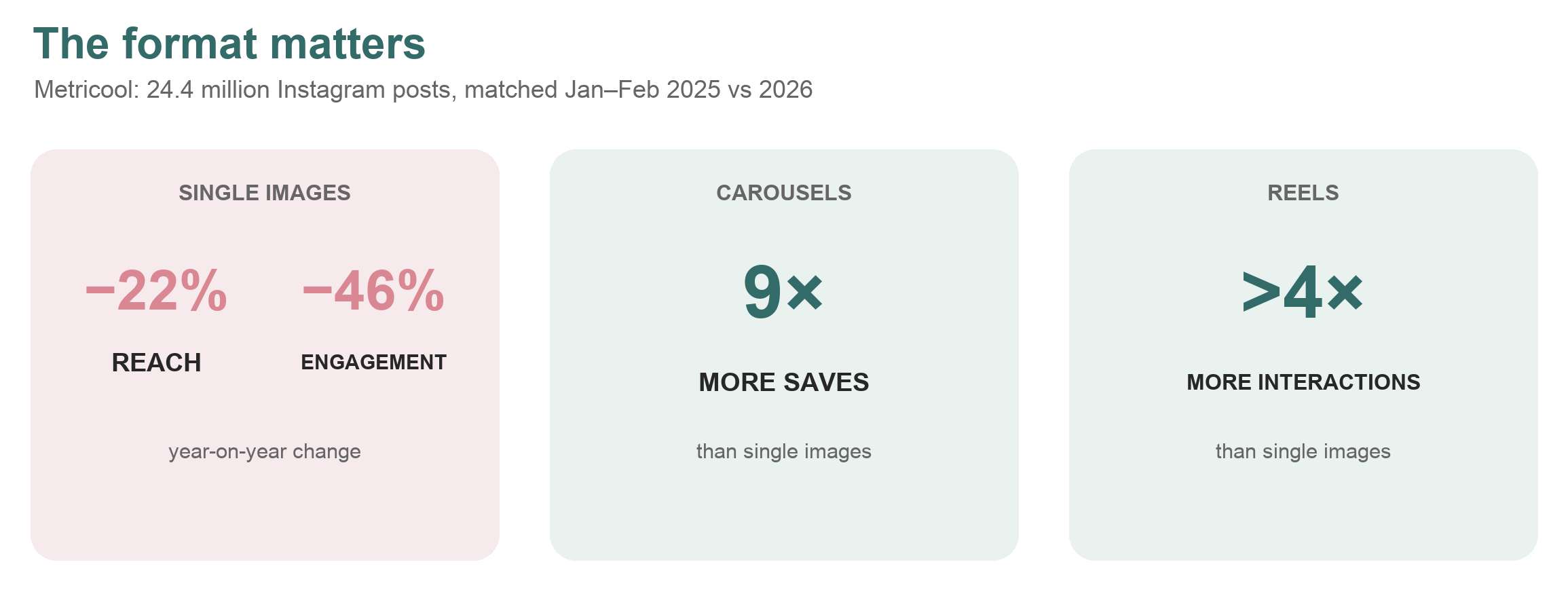
Different formats do different jobs. These figures compare formats, not the quality of the products in them.
Before binning product content, show the same item another way: in use, in a room, being made, being chosen, being wrapped or solving a small problem. A carousel can give someone detail to save. A short video can show scale or movement. You do not need to become the Martin Scorsese of throw cushions; you do need to give the product a little more to do than sit there.
2. ‘People buy from people’ does not mean your face must be everywhere
That phrase came up repeatedly in the comments on Jo’s post, but it is often taken far too literally.
Emplifi’s survey of 965 frequent US social-media users found 51% said a post featuring people like them had helped drive a purchase. That is not the same as saying they need a daily founder monologue.
A customer’s kitchen counts. So does a member of staff, a pair of hands, a familiar problem, a real review or a glimpse of how the work gets done. If you enjoy being on camera, use that strength. If you hate it, please do not assume the only alternative is to communicate through the medium of a lonely vase.
Personality is useful; compulsory oversharing is not. Share enough to make the business feel human and distinctive, while keeping whatever boundaries allow you to switch off at the end of the day.
3. Selling is allowed. Joyless selling is the bit people dislike.
In the same Emplifi research, the most common reason people gave for following a brand was news about promotions, sales and discounts, at 64%. When asked what had driven a purchase through social media, 60% cited a discount or promotion. People may say they hate being sold to, yet they still follow for offers and buy from them. Humans: reassuringly inconsistent since forever.
There’s no sign that ordinary selling is algorithmically penalised either. Instagram CEO, Adam Mosseri has said that sponsored posts are not downranked and that saying ‘link in bio’ does not affect reach. Also, Meta’s published list of content it demotes does not include ordinary promotional posts.
The problem is usually selling with no relevance, context or reason to care. Show who the product is for, why it is useful, what makes it different and what the buyer should do next. Price and availability are not dirty words. Making someone play detective to find them is not a premium customer experience.
4. Use trends as seasoning, not the main meal
Sprout Social found that 1/3 of consumers think it is embarrassing when brands jump on viral trends, while 93% said it matters that brands understand online culture.
A little contradictory, perhaps? I don’t think so. Knowing the room is useful; copying everything happening in it is exhausting.
Use a trend when it suits your audience, you can add a relevant point and the idea still makes sense after the sound has disappeared. Otherwise, leave it. The Instagram police will not arrive.
5. Judge content by the job it was meant to do
A Journal of Marketing meta-analysis found that the content most likely to drive engagement is not always the content most likely to drive sales. Emotional content tends to perform better for engagement; functional, product-benefit content performs better for sales.
So a useful product post can look underwhelming in the likes column while quietly sending people to the website. Meanwhile, a funny Reel can reach thousands and sell precisely nothing. Neither has failed if it did the job you gave it.
Jo’s post is a good example. It showed no product, price or link, yet within 24 hours at least six people said they had found the account through it and followed. The replies also led to a shop introduction and an overseas shipping enquiry. Not bad for a post that didn’t try and sell a single product.
What I’d actually do
- Keep a mix you can sustain. Use product, people and useful context in proportions that fit your business. Consistency beats a content personality transplant.
- Test the format before blaming the subject. Put the same product into a carousel or short video and compare saves, sends, site visits and enquiries – not just likes.
- Ask your own customers. Jo’s thread included many fellow business owners talking about their own experience. Useful, but not necessarily identical to your buyers.
- Apply the send test. Would one person send this to another with ‘this is so you’? If not, it is less likely to travel beyond the people who already follow you.
- Show humans without surrendering your privacy. Customers, staff, makers, hands, homes and real-life situations all count. Your breakfast can remain confidential.
- Choose one commercial measure for the next quarter. Try sessions from Instagram, DMs that become orders, email sign-ups or discount codes redeemed. One clear number is more useful than anxiously refreshing six vague ones.
- Post less if that makes the content better. Volume for its own sake is not a strategy. Nobody starts a small business because they dream of filming Reels on a Tuesday.
So keep showing your products. Just give people a reason to care, and a clue about what to do next.
A quick note on the numbers
I counted the comments at 10.22am BST on 24 August 2026. Each of the 209 people other than Jo was coded once, using everything they wrote. The categories followed the choices raised in Jo’s carousel, and some responses required judgement.
This was a self-selecting comment section from one account, not a representative survey. The counts show what happened in that conversation; the wider studies provide the broader context.
Sources
- @sosouk, the original Instagram post (23 August 2026)
- Markel UK / Censuswide: 501 UK small-business owners (July 2026)
- Metricool 2026 Instagram Study: 24.4 million posts
- Sprout Social Index: 4,044 consumers
- Emplifi, The Social Pulse: 965 US consumers
- Journal of Marketing meta-analysis, via the American Marketing Association
- Adam Mosseri on ‘link in bio’, via Social Media Today (July 2025)
- Meta Transparency Center: types of content we demote